
Alex is an operations leader at a manufacturing plant. He’s aware that his IT team collects massive amounts of data like production counts, downtime logs, quality reports, inventory levels, and labor availability.
Every system is capturing something, yet when Alex needs answers, the data rarely helps.

He still struggles to answer basic operational questions:
-
Why did output drop last week?
-
Are we headed toward a downtime issue?
-
Which line is actually our bottleneck today?
-
Why do different teams give different numbers for the same metric?
The problem isn’t a lack of data. It’s that manufacturing systems aren’t connected in a way that supports decisions.
The Impact of Disconnected Systems
Alex sees this challenge play out across the plant every day.
In most organizations critical information lives in separate systems:
-
Enterprise Resource Planning (ERP) systems manage orders, costs, and planning
-
Manufacturing Execution Systems (MES) track production and performance
-
Quality Management Systems (QMS) monitor defects and compliance
-
Computerized Maintenance Management Systems (CMMS) log equipment health track equipment health, work orders, and preventive maintenance
- Product Lifecycle Management (PLM) systems manage product design and engineering collaboration from concept to retirement
-
Supply Chain Planning (SCP) systems forecast demand and plan inventory, sourcing, and distribution
- Advanced Planning and Scheduling (APS) systems optimize production schedules based on constraints, capacity, and priorities
-
Laboratory Information Management Systems (LIMS) manage test data, samples, and quality lab workflows
-
Material Resource Planning (MRP) systems calculate material needs and timing based on production demand
- Customer Relationship Management (CRM) systems manage customer interactions, sales pipelines, and order commitments
Each system works as intended — but in isolation.
When these systems operate independently, they create data silos. Data becomes fragmented across multiple sources, making it difficult to gain a unified view of operations.
A Common Manufacturing Scenario
Alex has seen this scenario more times than he can count.
A machine goes down, maintenance logs the issue, production adjusts output manually, scheduling updates later, and Operations leadership only sees the impact after the fact. But the impact doesn't stop there. Sales, unaware of the disruption, commits to expedited orders for a priority customer. Customer Service continues promising original delivery dates. Supply Chain places material orders based on outdated production forecasts. Engineering, running a prototype on the same equipment, loses its testing window and delays a product launch. Finance doesn’t see the cost impact (overtime, scrap, missed revenue) until after month-end.
Each system works — but not together.
This gap between events and visibility is what makes day-to-day decision-making so difficult.
Instead of responding in real time, Alex often finds himself chasing confirmation—checking multiple systems, meeting with cross-functional teams, or waiting for updated reports. Decisions still get made, but they’re based on partial visibility. The cost isn’t just slower response times; it’s increased risk, rework, and missed opportunities to intervene before small issues turn into major disruptions.
For Alex, the frustration isn’t missing data — it’s that no system shows the full operational picture when it matters most. By the time Alex makes one decision, there's always another issue waiting to be solved.
When systems don't work together familiar patterns emerge:
-
Operators track performance on whiteboards or spreadsheets
-
Supervisors keep their own reports to run the shifts
-
Leadership sees multiple versions of the “same” numbers
-
Sales requests extra buffer inventory “just to be safe”
-
Production overbuilds to protect service levels
-
Supply Chain inflates safety stock and lead times
-
Customer Service manages promises manually and escalates late orders
-
Engineering builds in extra time for prototyping
None of this happens because people want to bypass systems. It happens because they need answers — and the systems can’t provide them together.
This is how fragmented data quietly multiplies across a plant.
The Hidden Cost of “Shadow Data”

As teams create their own datasets to fill the gaps...
-
Data is entered multiple times
-
Numbers drift out of sync
-
Trust in reports breaks down
-
Decisions slow down even further
Over time, this manual layer becomes the real source of truth — even though it’s incomplete, outdated, and difficult to maintain.
Instead of fixing disconnection, it perpetuates it.
What Is Data Integration in Manufacturing?
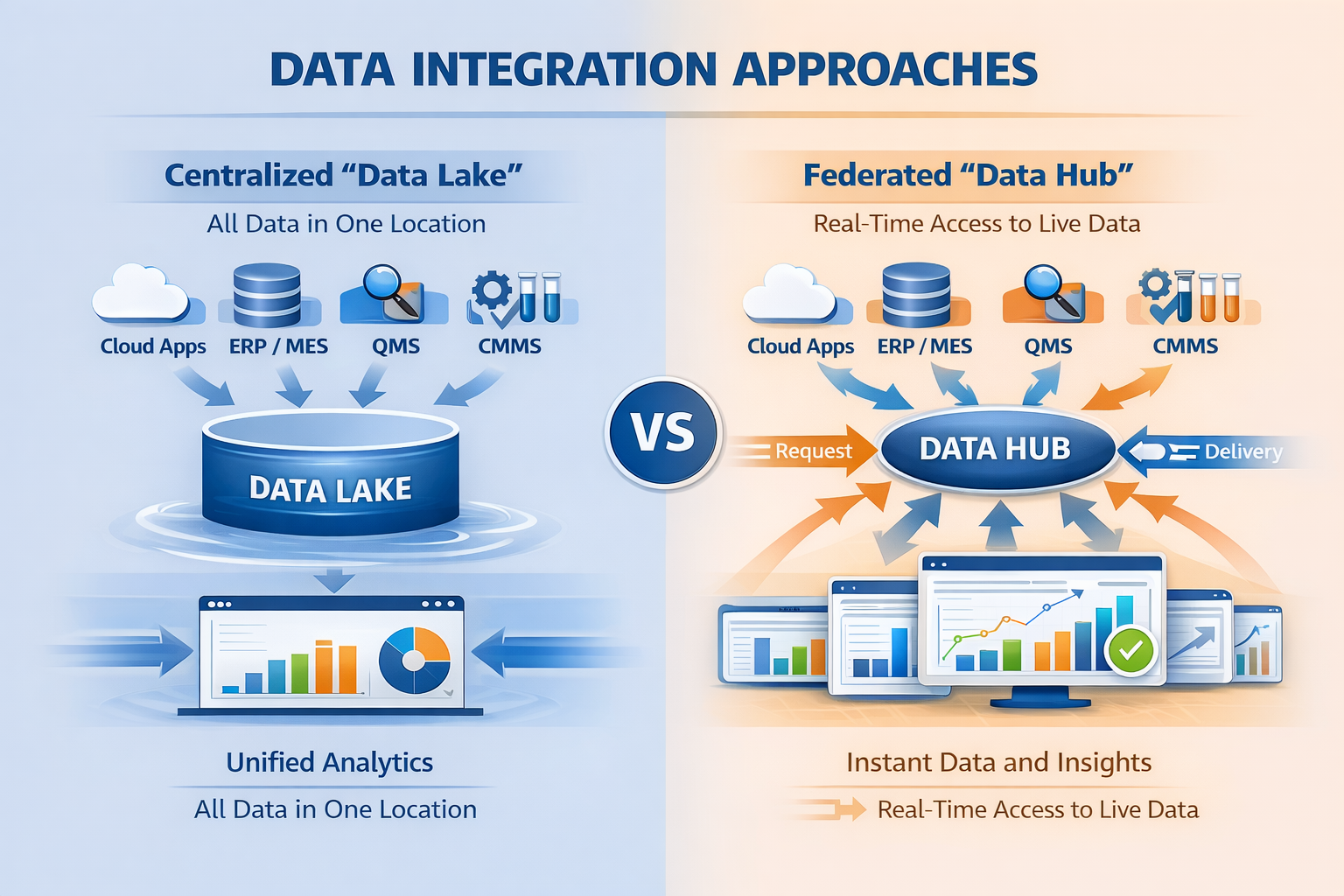
Data integration refers to the process of combining data from multiple sources to create a unified view of data across manufacturing. Organizations have multiple data sources such as cloud services, applications, and databases.
Data integration can be done in two main ways. One data integration approach is bringing all data in one central location--- a data lake. The second approach is using software that connects data from the source and brings it to where it is needed. Data integration helps organizations achieve unified, actionable insights, which are critical for analytics, automation, and regulatory compliance.
For operations leaders like Alex...
Integrated data builds a foundation to help answer questions like:
-
What is happening right now across production, quality, maintenance, inventory, and labor?
-
Why did performance change — and where did it start?
-
Which constraints are affecting output today?
-
What will happen if schedules, staffing, or priorities change?
A data integration solution is essential for decision making, managing the complexity, and ensuring seamless data flow to drive operational efficiency.
How Data Integration Supports Manufacturing Decisions
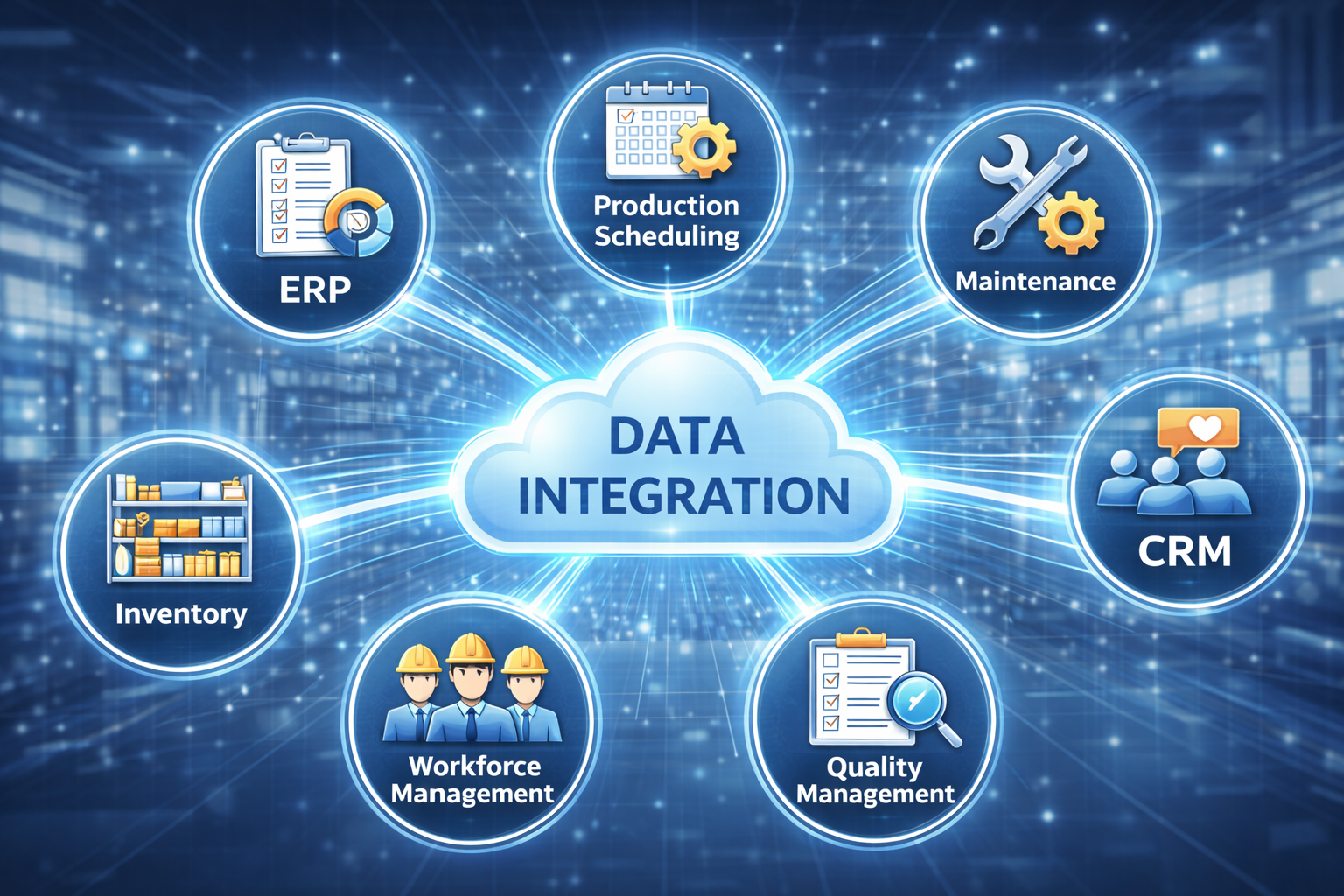
Manufacturers use data integration to connect information across the entire production lifecycle:
-
Planning and scheduling
-
Production execution
-
Quality and compliance
-
Maintenance and asset health
-
Inventory and delivery
- Financial performance and cost control
- Customer demand and feedback
- Engineering changes and product trials
When this information is connected, data becomes part of daily decision-making — not something reviewed only after problems occur. For Alex, that means fewer surprises, faster responses, and better alignment across teams.
Common Data Integration Tools in Manufacturing
Data integration tools ingest, consolidate, and standardize information so teams can rely on the same data across the organization. Data integration systems in manufacturing leverage various methods to harmonize data and enable better decision-making across the organization.
ETL (Extract, Transform, Load)
ETL processes begin with data ingestion, where raw data is collected from source systems. The next step is data transformation, converting the raw data into a standardized format suitable for analysis. Finally, the process involves loading data into a data repository. Accurate data is essential at every stage to ensure reliable analysis and reporting. ETL workflows support processing data in both batch and real-time scenarios, enabling timely insights and decision-making.
This approach is commonly used for:
-
Historical analysis
-
Reporting and dashboards
-
Trend identification
It helps people like Alex analyze data regarding plant performance and recurring issues.
Data Virtualization
Data virtualization provides real-time access to data without physically moving it. This approach allows users to access data from multiple systems without needing to transfer data physically. A virtual layer connects to multiple systems, enabling organizations to handle large data volume and unstructured data, making it ideal for enterprise data environments. Decision-makers can view current operational data, such as labor availability or machine status.
This approach is commonly used for:
-
Real-time operational visibility
-
In-shift decision-making
-
Cross-system data access
-
Monitoring live conditions
For operations leaders, this means visibility into current conditions during a shift — not the next day.
APIs (Application Programming Interfaces)
APIs are a common data integration method for application integration, enabling systems to exchange information automatically. For example, maintenance data can trigger production schedule adjustments and workforce notifications without manual intervention.
APIs facilitate real time data integration by processing streaming data between systems and cloud services, allowing organizations to gain immediate insights and support real-time analytics. They help ensure the same data is available and consistent across platforms, support data migration and data replication tasks, and offer a simple data integration approach for many use cases.
This approach is commonly used for:
-
System-to-system communication
-
Real-time event handling
-
Automated workflows
-
Triggering alerts and actions
APIs automate how systems respond to changes without manual intervention.
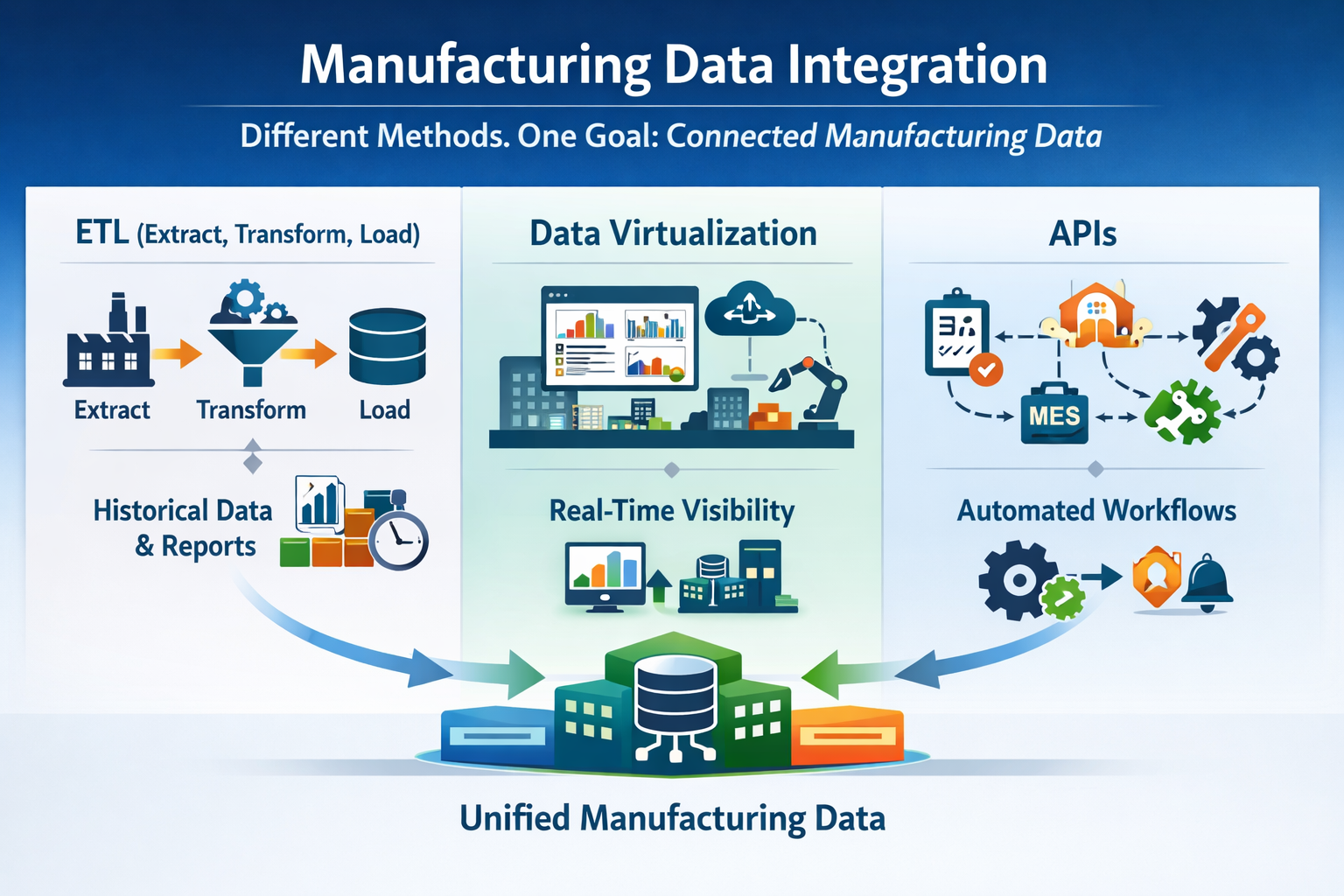
Many manufacturers use a hybrid data integration strategy to support both historical reporting and real-time operational needs.
Key Benefits of Data Integration for Manufacturing Operations
In Alex's operational reality, data integration delivers tangible benefits.
Enhanced Operational Visibility
A single view of relevant data in production, quality, inventory, and maintenance.
Improved Decision-Making
More accurate, timely information to support confident decisions.
Increased Operational Efficiency
Less manual data entry and fewer spreadsheet-driven workflows.
Faster Issue Resolution
Earlier identification of problems to reduce downtime and disruptions.
Scalable Manufacturing Data Infrastructure
A data foundation that adapts to new technologies, sources, and growth.
7 Manufacturing Intelligence Use Cases: Data Integration
These use cases reflect the situations Alex faces throughout the week—missed signals, late adjustments, and decisions made with incomplete context. They aren’t abstract initiatives or theoretical improvements. They show up during shifts, handoffs, and disruptions, when timing matters and clarity is limited. When data integration is working, these use cases move from theory into daily operations, helping teams respond earlier and with greater confidence.
1. Predictive Maintenance
Integrated sensor and machine data reduces unplanned downtime and maintenance costs, enabling operations leaders to determine whether extending asset life or investing in new equipment is the better capital expenditure decision.
2. Root Cause Analysis
Connecting ERP, MES, and quality data reduces scrap and rework, improves first-pass yield, and prevents recurring defects that impact customer satisfaction and margins.
3. Demand Forecasting
Integrating CRM, inventory, and production data improves inventory turnover, reducing overproduction, excess inventory, and working capital tied up in stock.
4. Regulatory Compliance and Reporting
End-to-end data traceability shortens audit cycles and reduces compliance risk, helping avoid production holds, delayed shipments, and regulatory penalties.
5. Supply Chain Visibility
Integrated inventory, ERP, and transportation data enables earlier identification of disruptions, improving on-time delivery, manufacturing cycle-time, and reducing expediting costs.
6. Workforce Productivity
Connecting labor availability, skills, and production data improves staffing and shift decisions, reducing overtime, labor inefficiencies, and missed output targets.
7. Production Scheduling
Real-time data across demand, materials, labor, and equipment allows schedules to adapt dynamically, improving throughput, capacity utilization, schedule adherence, and customer satisfaction.
A Common Data Integration Challenge: Data Quality
Even after systems are connected, Alex still encounters a familiar challenge: data quality.
In manufacturing, data quality problems rarely exist in isolation. They are often a symptom of disconnected systems and unclear governance around how data should support decisions.
Data quality describes whether manufacturing data is reliable enough to support operational decisions.
Through Alex's lens, poor data quality doesn’t show up as missing values or bad schemas.
Poor Data Quality shows up as...
-
Conflicting reports across teams
-
Missing context around production events
-
Delayed visibility into issues
-
Low trust in system data
High data quality means data is accurate, timely, consistent, and usable for decision making.
Alex doesn’t expect perfect data. He expects data he can rely on when it’s time to act.
Why Data Quality Problems Persist — Even After Integration
Many manufacturers integrate systems expecting data quality issues to disappear.
Data starts flowing between ERP, MES, quality, and maintenance systems.
Yet Alex still hears...
-
“These numbers don’t match.”
-
“We didn’t see this coming.”
-
“We only realized it after production was impacted.”
The problem isn’t integration alone — it’s data discipline and trust.
When teams don’t trust the data, they work around it. Over time, small inconsistencies compound into conflicting metrics and delayed signals.
This is where data quality and data governance intersect.
A Practical Cross-Functional Operations Example
Alex oversees a large manufacturing facility with multiple production lines.
One of the facility’s assets supports both high-volume production and engineering trials. The systems are integrated — maintenance, production, quality, planning, and sales all capture data related to that asset.
Over several weeks, the data begins to shift.
Maintenance data shows a steady rise in vibration and temperature, still within allowable limits.
Production reports slightly longer cycle times, but output targets are met.
Quality sees a small increase in rework, not enough to trigger an escalation. Sales continues committing to delivery dates based on planned capacity. Engineering schedules a product trial on the asset, assuming it remains available.
No single system raises a critical alert. Each function sees only part of the picture.
Then the asset fails.
Multiple production lines stop. Customer shipments are delayed. Engineering trials are canceled. Supply chain inventory piles up. Expediting and overtime costs spike as teams scramble to recover.
The data existed the entire time.
The systems were connected.
What was missing was a cross-functional decision that depended on the data before failure occurred.
By the time the issue was obvious to everyone, the only options left were reactive ones.
What Data Governance Means for Operations
Data governance defines how data is expected to influence decisions. It's about rethinking the logic behind decision-making.
Data governance answers practical questions...
-
Which system is trusted for this metric?
-
When does variation require action?
-
Are thresholds enough, or do trends matter?
-
Who is accountable for responding?
In Alex’s case, governance existed only at the point of failure. There was no guidance for acting earlier.

How Governance Improves Data Quality in Practice
From Alex’s perspective, data quality only becomes visible when it directly affects a decision. As long as data is collected but not relied upon, quality issues remain hidden. Governance is what changes that dynamic. By defining which data matters, when it should trigger action, and who is accountable, governance creates dependency on the data. Once decisions depend on it, inconsistencies, gaps, and delays surface quickly—because they now block action instead of sitting unnoticed in the background.
When data governance is clear...
-
Teams stop redefining metrics
Because definitions are shared and tied to real decisions. -
Reports stop conflicting
Because data comes from governed sources instead of local interpretations. -
Manual workarounds decrease
Because teams trust the integrated data and no longer need spreadsheets. -
Errors get noticed sooner
Because bad data now blocks a decision — and someone is accountable for fixing it.
This is how data quality improves sustainably in manufacturing.
Not because the data magically gets cleaner — but because the data now matters.
How Data Governance Creates Data Dependency
For data integration to actually work, you must depend on the data to make a decision. Availiability of data does not guarantee its usage. Data only becomes operational when governance explicitly connects it to decisions, timing, and accountability.Once decisions depend on data...
-
Quality issues surface faster
-
Inconsistencies get fixed
-
Trust increases
This is the turning point where integrated data becomes operational. Without governance, even high-quality, integrated data will sit unused
Connecting Manufacturing Data to Daily Decisions
You already generate massive amounts of data. The difference between reactive and proactive organizations isn’t data volume. It’s whether data is connected to decisions.
By integrating systems and applying clear data governance, organizations create data dependency — and that dependency is what drives better data quality, better decisions, and better outcomes.
You already have the data.
Data integration, supported by strong data governance, is how you finally get to use it.



No Comments Yet
Let us know what you think